

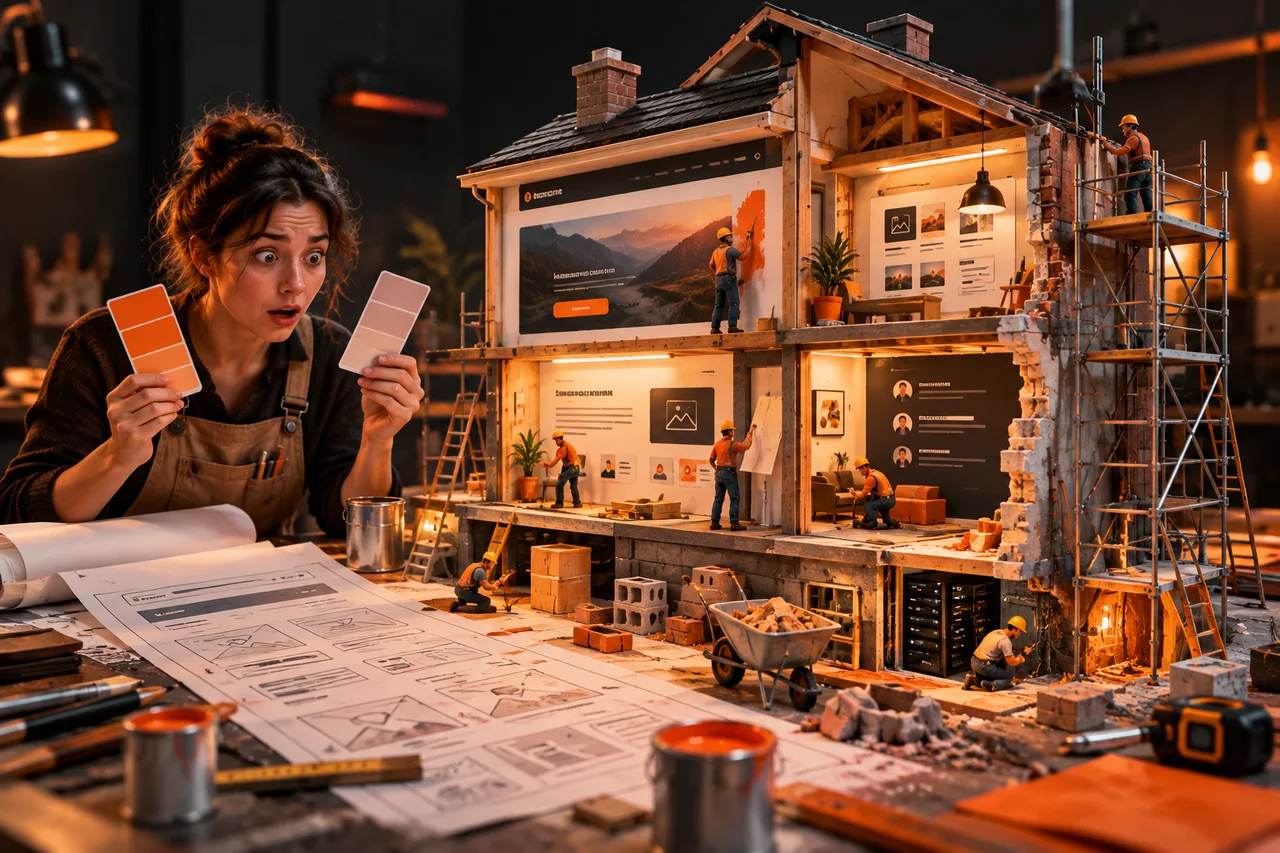
Just want to change two colors? The site has other plans
It often starts the same way. You open your site, you find it a little dated, and you say to yourself that a little refresh would do the trick. A new palette, two visual adjustments, and it will be fixed.
In reality, it’s rarely that simple.
As soon as we start a site redesign WordPress, we quickly discover what is hidden behind the interface. A plugin abandoned for several years, a theme incompatible with recent versions, or even a structure tinkered with over time. What seemed like a simple touch-up then becomes a real project.
As in renovation, it is never the painting that poses a problem. These are the walls.
Redoing a website is not aesthetic, it’s strategic
A good web design is not about making a site prettier. It consists of making it more efficient.
Today, a site must load quickly, adapt perfectly to mobile, and guide the user without friction. Otherwise, it loses visitors. And above all, he loses customers.
This is where the notion of performance becomes essential. Criteria such as Core Web Vitals (Google indicators to measure the real quality of the user experience) directly influence your positioning on Google. A slow or poorly optimized site simply won't be competitive.
You can learn more directly about Google's official recommendations via https://web.dev/vitals/
So, redoing a site is not just about reviewing the design. It means rethinking its entire operation, from its structure to its secure web hosting.
Behind the design, there is programming (and a lot of invisible decisions)
A successful WordPress site is based on precise technical choices. Should you use a visual builder or custom development? Should we optimize the images or completely review the structure of the pages?
These decisions are not immediately visible. However, they have a direct impact on the speed, stability and SEO of the site.
For example, a simple conflict between two extensions can slow down a site drastically. A poorly designed theme can harm mobile accessibility. And poor redirect management can make your SEO disappear overnight.
In other words, the website programming is never a detail. This is the foundation.
SEO does not forgive poorly done renovations
During a redesign, many sites lose traffic. Not because the content is bad, but because the transition was poorly managed.
Changing URLs without redirection, modifying the structure of pages or deleting strategic content can have immediate consequences. Google is not giving any gifts.
This is why a good site creation WordPress always includes SEO thinking from the start. Structure of titles, hierarchy of pages, internal linking… nothing is left to chance.
Moreover, if you want to understand why certain sites appear on Google and others not, this article on SEO will give you a good overview: SEO: the mysterious spell that makes your website appear in Google (or not).
If you want to learn more about these best practices, you can also consult the official Google Search Central guide: https://developers.google.com/search.
Why a local programmer is a game changer
At this point, you might think that any developer can handle this type of project. Technically, yes. In reality, it's a different story.
A local programmer understands your market, your constraints and your objectives. He knows how to adapt your site to the realities of Quebec, particularly in terms of compliance, such as with Bill 25.
But above all, it is accessible. You can exchange quickly, adjust decisions and avoid misunderstandings.
Hiring a remote developer may seem economical. However, when problems arise, delays lengthen and solutions become unclear. And in a web project, problems always arise eventually.
A successful redesign is a site that lasts over time
A good site cannot be judged only when it is put online. It is judged over time.
Is it easy to update? Is it stable? Is it still performing well in a year?
This is where the difference between a quick redesign and real web design becomes apparent. A serious approach anticipates developments, secures the site and facilitates its web maintenance.
It is also based on a real design and development process to avoid costly improvisations and ensure long-term consistency.
In conclusion: it is better to open the walls with an expert
Remaking a website is never a superficial operation. It is an opportunity to start again on solid, efficient and sustainable foundations.
But as with renovation, it is better to know what you are doing before you start demolishing.
Calling on a local professional allows you to avoid unpleasant surprises, make the right technical choices and build a site that really works for you, with real logic. sustainable website design.
And if you were just thinking about changing two colors... now you know why that's never the real issue.